

Electronic systems usually receive a power-supply voltage that is higher than the voltage required by the system’s circuitry. For example, a 9 V battery might be used to power an amplifier that needs an input range of 0 to 5 V, or two 1.5 V batteries in series might provide power for a circuit that includes 1.8 V digital logic. In such cases, we need to regulate the input power using a component that accepts a higher voltage and produces a lower voltage.
One very common way to achieve this type of regulation is to incorporate a linear voltage regulator.
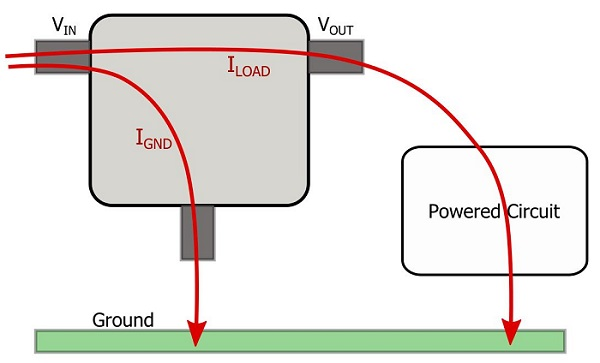
Diagram of a fixed-output-voltage electronics.com/blog/what-is-a-linear-voltage-regulator">linear regulator
How Does a Linear Voltage Regulator Work?
Linear voltage regulators—also called LDOs or low-dropout linear regulators—use a transistor controlled by a negative-feedback circuit to produce a specified output voltage that remains stable despite variations in load current and input voltage.
A basic, fixed-output-voltage linear regulator is a three-terminal device, as shown in the diagram above. Some linear regulators allow you to adjust the output voltage by means of an external resistor.
Drawbacks of Voltage Linear Regulators
A serious disadvantage of linear regulators is their low efficiency in many applications. The transistor inside the regulator, which is connected between the input and output terminals, functions like a variable series resistance; thus, high input-to-output voltage differential combined with high load current results in large amounts of power dissipation. The current required for the functionality of the regulator’s internal circuitry, labeled IGND in the diagram, also contributes to total power dissipation.
Perhaps the most likely failure mode in a linear-regulator circuit derives from thermal rather than strictly electrical factors. The power dissipated by the regulator IC will lead to increases in component temperature, and without adequate pathways that allow heat to move away from the regulator, the temperature may eventually be high enough to seriously impair performance or cause thermal shutdown. This important topic is covered in AAC’s article on thermal design for linear regulators.
Linear Voltage Regulator Applications
Though linear regulators are typically inferior to switching regulators with regard to efficiency, they are still widely used, for several reasons. Major advantages are ease of use, low output noise, and low cost. The only external components required by most linear regulators are input and output capacitors, and capacitance requirements are flexible enough to make the design task very straightforward.