

Microchip Technology has announced a new, production-ready 1,200-V digital gate driver that provides multiple levels of control and protection.
Microchip Technology has announced a new, production-ready 1,200-V digital gate driver that provides multiple levels of control and protection. The new device complements Microchip’s broad portfolio of discrete products and silicon carbide MOSFET modules to reduce switching losses by up to 50% and accelerate time to market for the transportation market. The new technology enables electric buses and other electronic transportation power systems to meet and exceed stringent environmental conditions while maximizing efficiency.
Rob Weber, product line director for DGD Discrete and Power Management at Microchip, said in an interview with Power Electronics News that after Microchip acquired AgileSwitch, the team set a goal of developing a gate driver IC specifically for SiC with Microchip’s switching technology, all integrated into a new gate driver base board. “Along with this, we are introducing a new version of the configuration software [ICT], the intelligent configuration tool that allows the design to be very easily configured with the gate driver,” said Weber.
Weber also noted how the application scope is targeted for high-power applications, such as APUs for transportation, trains, trucks, trolleys, buses, and other heavy vehicles, but also for the powertrain of these electric vehicles. “We see a lot of interest in renewable energy as well as grid infrastructure; applications for renewables, especially above 50 kW, as well as in grid infrastructure with solid-state transformers and power-factor conversion,” he added.
Silicon carbide
In industrial applications, SiC semiconductors offer cutting-edge technology in terms of efficiency, form factor, and operating temperature. SiC technology is now widely accepted as a reliable silicon substitute. Several power module and power inverter manufacturers have set the groundwork for SiC usage in their product roadmaps. Electromagnetic interference (EMI), overvoltage, and overheating are some of the design problems that SiC presents.
SiC power technology allows EV and other high-power switching applications to achieve maximum efficiency. System designers are adopting SiC solutions to overcome the efficiency limitations of traditional, silicon-based devices.
Over the previous three years, the market for SiC power semiconductor devices has risen. The market is optimistic that it will reach $10 billion in the next seven to 10 years. We’re seeing a lot of adoption and a lot of possibilities are being worked on all around the world. These possibilities are available in a variety of industries, including industrial, automotive, medical, aerospace and defense, traction or railway, and others.
Digital control for SiC
For designers of SiC-based power-conversion equipment, Microchip’s AgileSwitch 2ASC-12A2HP 1,200-V dual-channel digital gate driver with its Augmented Switching technology is production-qualified and fully configurable.
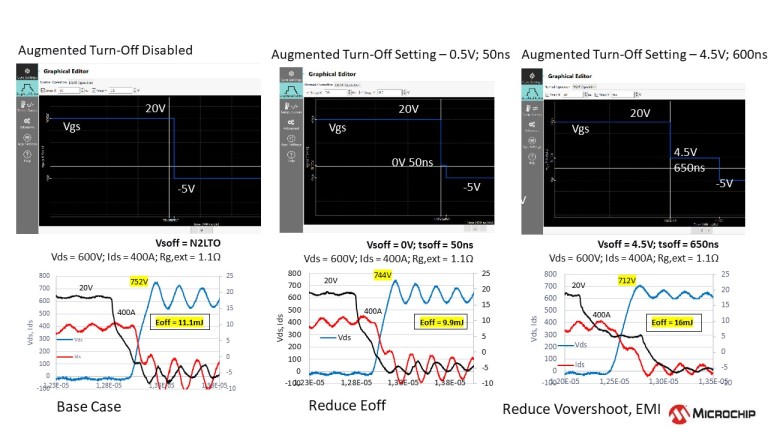
Weber pointed out that Augmented Switching is a technique whereby we turn the device on and off in controlled steps, where we control the time and the voltage level of each step. And by doing this and modifying these steps through a software interface very precisely, the desginers are able to get rid of false faults, mitigate ringing, lower EMI, and reduce voltage overshoot and undershoot.
Key performance features of AgileSwitch gate driver devices, according to Weber, include the ability to attenuate drain-source voltage overshoots by up to 80% and minimize switching losses by up to 50% when compared with traditional gate drivers. The 2ASC-12A2HP digital gate driver has an isolated DC/DC converter with a low-capacitance isolation barrier for pulse-width–modulation signals and error feedback and can generate up to 10-A peak current.
“Fixed on and off are common in traditional solutions,” said Weber. “Gate resistors are used to turn things on and off. Some have added more stages, although gate resistors are still the primary controllers. And with our initial generation, we had two degrees of customizable on and off. After then, there were three layers of short-circuit. However, for normal operation, we introduced a turn-on level and an extra turn-off level, as well as an additional level for short-circuit operation, with the new offering in the second generation. As a result, we developed our own completely integrated IC that may increase processing speed while also improving functionality.”
The newest version of Microchip’s Intelligent Configuration Tool (ICT), which allows users to customize gate driver characteristics such as gate-switching profiles, key system monitors, and controller interface settings, is compatible with the 2ASC-12A2HP gate driver. ICT may save designers three to six months of development time for new designs, according to Microchip.
“With our software, you can see the on and off voltages, as well as multiple levels for normal and shorted operation, and then several features related to the control processor, including dead time, reset, monitoring for DC link, voltage, and temperature,” said Weber.
By reducing turn-off spikes and ringing, under normal operation as well as under short-circuit (DESAT) conditions, SiC MOSFET modules can be safely operated at higher switching frequencies that enable dramatic increases in power-conversion density. This allows SiC MOSFET modules to be operated closer to their rated specifications, resulting in size, cost, and performance improvements.
These programmable digital gate drivers provide a different solution than standard analog drivers because they prevent false faults and reduce EMI.
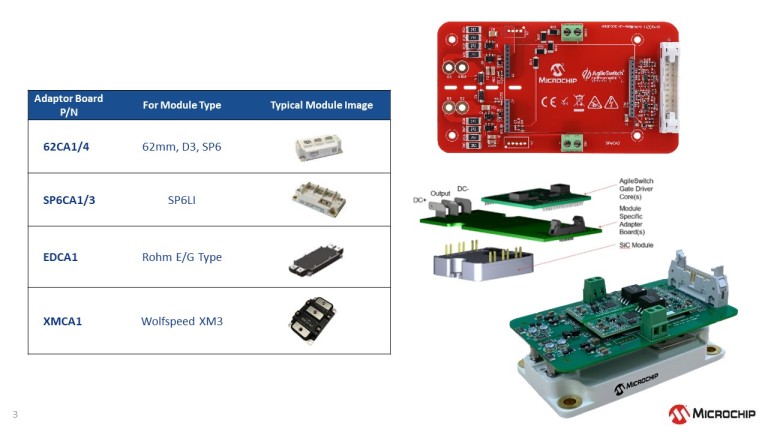
Microchip’s 2ASC-12A2HP gate driver is compatible with the company’s broad portfolio of SiC power devices and modules and is interoperable with SiC products from other manufacturers. A family of module adapter boards also supports the gate driver and the company’s Accelerated Augmented Switching Development Kits (ASDAKs) that include gate drivers, module adapter boards, a programming kit, and ICT software for SiC MOSFET modules.